Case study 02
Shopify — Mason Mobile POS
Disjointed point-of-sale devices create clutter and inefficiency for retailers. The opportunity was to design a unified counter-top mobile POS system that adapts to different store workflows instead of forcing every store into one fixed layout.
Industrial design / Product architecture / DFM
- Client
- Mason for Shopify
- Sector
- Retail hardware
- Scope
- Industrial design, product architecture, DFM
- Output
- Concept system → production-intent CAD
The problem
Retail counters accumulate hardware: a tablet, a card reader, a scanner, a receipt printer, and the cabling to hold it all together. Each addition makes the counter harder to use and harder for staff to learn.
The design brief was a modular POS platform that could scale across store types — from a single-register boutique to a multi-lane flagship — without redesigning the hardware for each case.
Approach
Work started from context and inspiration research: how merchants stand, reach, hand over, and recover the device during a transaction. That informed a stance and screen height that works both merchant-facing and customer-facing.
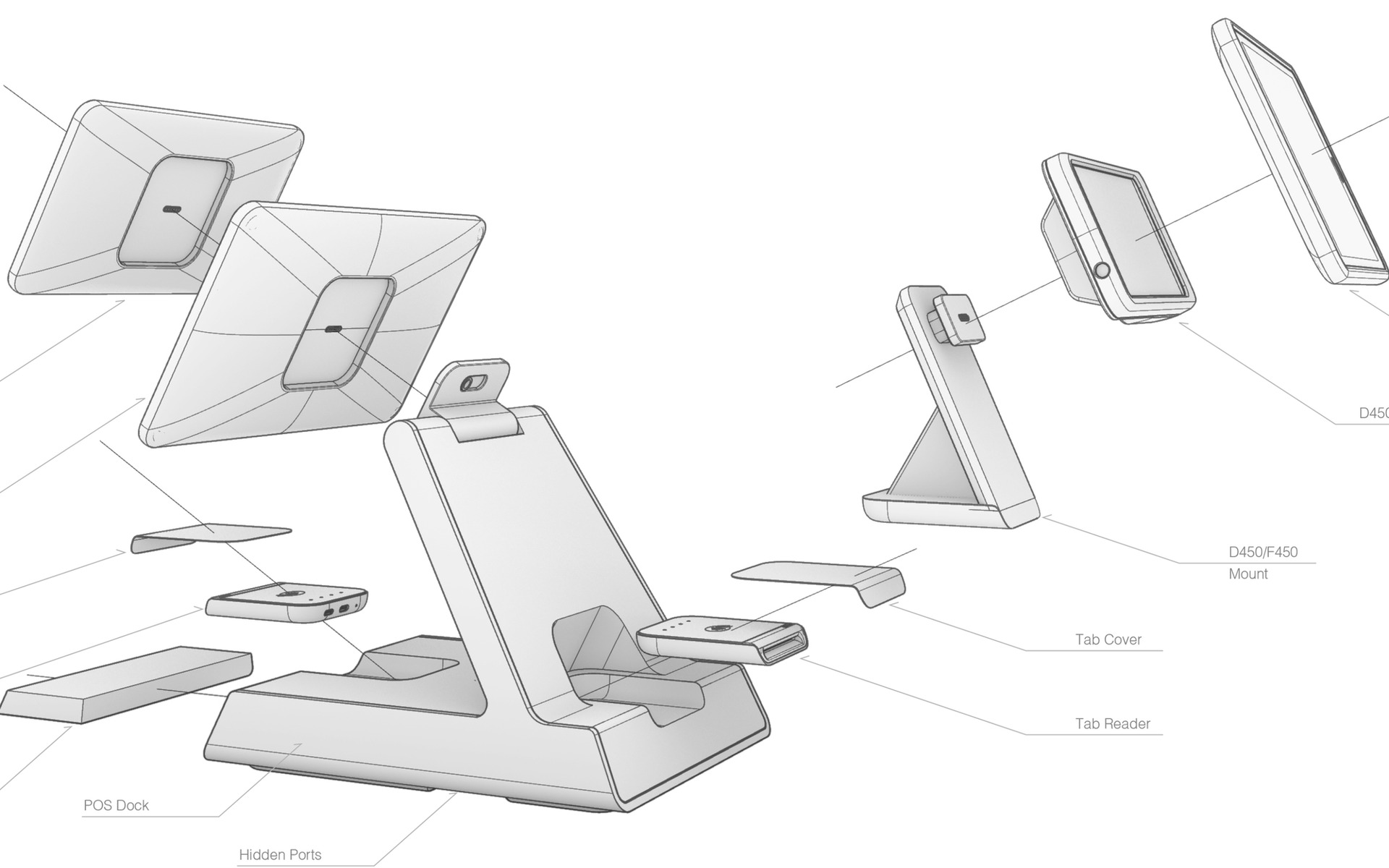
Concept exploration ran in parallel sketch families, then converged into a dock architecture: a weighted base with integrated tap module, a detachable 8-inch POS handheld, and a rotating screen for signature and payment hand-off.
Outcome
The result is a modular POS hardware system where dock, handheld, tap reader, and scanner share one product language and one mounting interface — documented through exploded views and production-intent surface CAD for engineering hand-off.
Contribution
- Context and inspiration research
- Concept sketch families and down-selection
- Product architecture and modularity strategy
- Form development, surface CAD, exploded documentation
- Design for manufacturing collaboration
Process & documentation


Previous
Lotte Beauty RetailNext
HTC Vive VR